It looks like I'm not the only blogger to ponder doing a media free day today. Obviously, I'm on the internet, so I didn't do it. To me a media free day means no: Newspapers, magazines, radio, television, movies, internet, books, music, etc. No media at all. What do you do? I'm not really sure. Think. Play some games. Talk with people. Take a walk in the woods?
Last year's events were probably the most well-covered stories by the U.S. media since television was invented (in terms of sheer volume). Did the media manipulate people's feelings or help them to cope better? Is this date an appropriate one to do a media free day, or is that ignoring what happened and dishonoring those who suffered? Are media free days in general a good thing, or a waste of energy?
Tuesday, September 10, 2002
It's Evolution Day today on the Collaboratory, so how about
WATCH its development into Hebrew and Aramaic!!
MARVEL at its morphing from Phoenician to Greek and then to Latin!!
WONDER as its many off shoots evolve from Greek to Cyrillic, Phoenician to Arabic!!
and much more...
The Evolution of the Alphabet
SEE its humble beginnings as Proto-Sinaitic glyphs!!WATCH its development into Hebrew and Aramaic!!
MARVEL at its morphing from Phoenician to Greek and then to Latin!!
WONDER as its many off shoots evolve from Greek to Cyrillic, Phoenician to Arabic!!
and much more...
One of the finest works of fantasy literature of the last twenty years is Guy Gavriel Kay's novel Tigana. This is the story of a kingdom which has been almost totally erased from memory by a powerful and evil wizard, and the struggles of its onetime citizens -- who are the only ones who remember Tigana, and who are the only ones who can even hear its name -- to restore their lost, loved land.
I was put in mind of Tigana by this TIME article about the rise of "virtual states" in today's world and the dangers they pose to "actual states". I posted the following to the message boards over at GGK's official site:
Any thoughts here? (BTW, if you haven't read any GGK yet, well, why on earth NOT?)
I was put in mind of Tigana by this TIME article about the rise of "virtual states" in today's world and the dangers they pose to "actual states". I posted the following to the message boards over at GGK's official site:
Last week, Time Magazine ran an article (which can be read here) which stated, among other things, that wars are likely to be much more dangerous in the coming century because of the rise of "virtual states", of which Al Qaeda is the prime example today. These are states that do not exist on any map; there are no natural borders, no capital city, nothing of the geographical reality that we typically take to be part-and-parcel of "statehood". But there are other aspects of statehood that exist: a trained standing army and intelligence cadre; a treasury and a source of revenue; a civil service and even a rudimentary welfare system for the families of its fighters.
The author of this article suggests that this nature of war -- i.e., that it will increasingly be waged between "real states" and "virtual states" -- will shift the moralities of war to a great degree. The author takes this to be a justification for the apparently-impending US action against Iraq, for example. (I'm not sure I buy that particular line of argument, but it's definitely the most intriguing justification for my country's wallow in unilateralism that I've seen yet.)
All this talk about "virtual states" and the nature of a war against a virtual state put me in mind of Tigana, for in some way Tigana is, in fact, a "virtual state". Even though it was once a real state on the map, now it only exists in the minds and hearts of its citizens; and the nature of Brandin's struggle against the Tigana that exists at the time of the events of the novel are completely different than the nature of the struggle of his against Tigana when it actually existed "on the map".
Of course, Tigana's hope is to rise again as a "real state"; and so, too, can that be said to be Al Qaeda's aim: the establishment of a theocratic pan-Islamic kingdom.
Any thoughts here? (BTW, if you haven't read any GGK yet, well, why on earth NOT?)
OK, I think this has the makings of a Front Page Post:
I commented on John's Vitruvian Man post that one might conclude there was a Designer.
Jason suggested (maybe only for the sake of argument, I don't know yet) that maybe natural selection could produce such results.
Then I say:
no, no, a resounding 'no'. do you think so? could natural selection have produced the beauty and intricacy we see in nature? no strings attached - what do you think? i find such a notion in-credible. which requires the bigger leap of faith - belief in a Designer (not talking Judeo-Christian God here, necessarily) or chance and natural selection? it's clear in my mind by orders of magnitude. but is that my own prejudice? what do you guys think?
Monday, September 09, 2002
This is for Jaq. I'll admit it's not quite as elegant but, what the hell, it's a...
A 15,139 Word Palindrome!
A man, a plan, a caddy, Ore, Lee, tsuba, Thaine, a lair, Uball, EHFA,Jaela, Gant, Masai, Liana, DVS, USES, Ojai, Ruyter, Geraint, Irbid,Naman, a milliard, Nahant, Epps, Argall, Emil, Lepus, a tort, a loon,Samia, HCM, a deme, Lenaea, glebae, Keon, a cart, seraphs, a suitor,Gilly, TSF, Fargo, Trask, Orissa, NbW, a pas, Arda, Bab, Undry, Bida,Sena, Eliott, Idaho, Nadda, Jasen, Egan, Nowata, SWA, jaws, Molina,Dalpe, Paz, Ilan, Igenia, Merth, Gupta, Omarr, Ocilla, Var, Ohara,Daktyl, an anaspid, Nemea, Nedda, Bayard, a toss, Italy, AHSA, Tagore,a psalm, Cannae, Soracco, rammi, Rota, Kaela, ZANU, Imo, Johns, a dey,Assad, Imitt, a ppl, Ogaden, Ivar, a sack, Conal, a hegari, Magel,Otina, Raddi, Lydie, Hagi, Asat, Alfadir, a canaille, Roca, Saharan, acoati, Elf, Rutan, agapai, Skaw, Sunay, B. Ag. Sc., MFS, a sruti, Hwu, anoddle, Fuji, Nissan, Repeal, Ugrian, a sag, Ravens, Enarete, Olfe,Losse, veeries, Sinan, Ida, Leckie, Ryle, Volapuk, Raman, Aigneis,Hapte, Biton, Enid, orgies, Inger, Daph, Inanna, Earvin, Utter, agumi, HCF, Logan, SbE, Beberg, Ito, Mohamed, O'Malley, a cain, amonomania, Rct, Tarragona, Musa, Yesima, Cavan, a sori, PSS, Nananne,Borg, a toga, Farron, Kasai, Hejira, Hapi, Bainter, Bataan, Ilke,Dunant, Callan, Woden, Ierna, Gamin, an ace, Lanier, Even, Uranus,Llano, Snapp, Elexa, Shu, LBP, Ont, Soho, York, UFC, paise, Dali,Zaller, Rubin, navettes, Usbeg, a hag, Radack, a name, Elkin, Nagy,Tasia, sambas, Sakkara, Boer, Ivan, Rolf, G. Katona, Jariah, Camag, atsar, Egeria, Tenn, a yaffle, Paton, Ripley, a gleet, Saida, Tsai, abetel, CIF, Tepper, Tsan, a soroban, Alia, Berey, Utamaro, Leix, Imre,herdmen, Imena, Likasi, Laclos, Oeflein, Netty, Pto, Sasha, Lufkin,Dunarea, Banda, Waite, DMD, Vetter, Eipper, Pareto, O'Fallon, Kale,Cramer, Iaso, Neosho, Basile, MSME, Garate, Poppo, mota, Lapsey,Blighty, a fuel, Axe, Dagan, a say', Gun, a mow, Ital, Este, Nodab,LaSorella, Krio, Nerissa, Cilo, Neisa, Casi, Laplace, Nessus,Palaemon, Egadi, ovaria, Hank, Emily, Hannan, an agron, a lam, Ronald,Bahia, Damalas, Ramon, Issachar, RATO, genae, Terceira, Koa, IJssel,Ruhr, a dekko, Orcadian, a tier, Katti, Lossa, visas, BAgr, Ebsen,Names, Rowan, Nils, Iobates, a lie, Taka, Busiris, Edmea, Hara, ...etc etc... a canal, Panama!Hand drawn holograms
One sunny day, William J. Beaty was walking through a car park (as you do) when he noticed a black car which appeared to have a series of interesting spots and highlights on its paint work. On closer inspection, he also noticed several hand prints which had a curious property, they didn't appear to be on the surface of the paint work at all but instead looked as though they were floating several inches below the surface and in some cases even looked like they were floating above it!
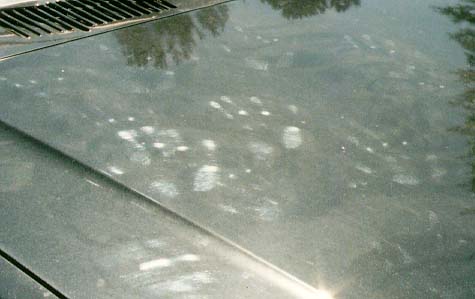 After some pondering about what he had seen he slowly came to realise that he had discovered a kind of holographic effect. But this kind of hologram didn't require all the usual paraphernalia such as lasers and mirrors nor was it caused by the traditionally understood holographic effect of light wave interference. In essence, a three dimensional image simply requires two different images to be presented, one to each eye and these images were being made up from the geometry of the scratches on the paintwork.
Imagine you are holding a piece of dark plastic outside in the sun. Now with a compass, make an arc in the plastic, (but do it softly: the arc needs to be dark and shiny not white and powdery). This arc is the equivalent of a scratch on the paintwork and when the sun hits it you will get a reflected highlight (a bright spot) at some point along the arc. If you close one eye the highlight will appear at one point on the arc, if you switch to the other eye, the highlight will appear at a slightly different place. This is because the angle of each eye is different relative to the sheet of plastic and the sun. As you vary the radius of this arc, the amount of displacement between the two highlights varies, the smaller the radius the more the positions of the highlights will differ. Now when you view the arc with both eyes open, the two highlights will combine to form a single highlight and the amount of displacement combines to create an apparent sense of how far away the highlight is from the viewer.
 So that's the basic phenomena but the interesting thing is that it is possible to use it to draw 3D images or holograms of just about anything.
 An image is made up of many points of light and is constructed by marking a sheet of black plastic with a great number of arcs. The illustration to the left demonstrates how to construct a simple "V" shape floating a few centimetres below the surface of a black plastic sheet. The radius of the compass corresponds approximately to the virtual depth of the object. Simply place one end of the compass at some point on the "V" and then make an arc at the top of the sheet, repeat this process over and over until you have covered as much of the "V" as possible and you have a series of arcs up at the top. Now take it out to view it in the sun or under a bright point source lamp.
You can find out more details about this interesting effect on this page, as well as how to go on and make more elaborate images such as 3D polyhedra.

Today's Spam
Subj: Rice ExportersDate: 09 Sep 02 18:21:26 +-0500
From: "Rice Exporters"
----------------------------------------------------------------
Dear Sirs,
We are exporters of rice, located in Lahore, Pakistan. We offer various
qualities of rice both white and parboiled, including Super Kernal, Basmati 385, Irri 9 and
Irri 6 at the best reasonable prices.
If you are interested in importing rice, please let us know, we might be able to help you. For additional details
please visit our site below.
Thanks for your time and patience.
Best regards,
The Secrets of Vitruvian Man
 If the work Leonardo Da Vinci is synonymous in the popular imagination with the art of the Renaissance, then surely the ubiquitous image of Leonardo's Vitruvian Man has become synonymous with Leonardo himself. The sketch which was made in one of his famous notebooks in 1492, demonstrates Leonardo's notions of ideal form and proportion. But in this he is merely illustrating the thoughts of another earlier thinker, that of the ancient Roman Vitruvius who wrote:
...in the human body the central point is naturally the navel. For if a man be placed flat on his back, with his hands and feet extended, and a pair of compasses centered at his navel, the fingers and toes of his two hands and feet will touch the circumference of a circle described therefrom. And just as the human body yields a circular outline, so too a square figure may be found from it. For if we measure the distance from the soles of the feet to the top of the head, and them apply that measure to the outstretched arms, the breadth will be found to be the same as the height ...
Note that the square when bisected at the navel forms two rectangles which are related by the Golden Ratio (which is to say that when looking at the smaller sides of each rectangle, the ratio of the two sides is equal to the ratio of the larger side and the side of the square itself). This kind of rectangle is said to be the visually most pleasing of all rectangles and one that is extensively used in classical architecture.

But only recently a new aspect of Vitruvian Man has come to light, that as well as demonstrating proportion, it contains within it an algorithm which attempts to solve one of the most ancient and intractable problems of Greek mathematics, that of Squaring the Circle.
Here is an interesting discussion of the mathematical inspiration behind Leonardo's most iconic work.
Sunday, September 08, 2002
Saturday, September 07, 2002
Oh, wow:
"A man, a plan, a caret, a ban, a myriad, a sum, a lac, a liar, a hoop, a pint, a catalpa, a gas, an oil, a bird, a yell, a vat, a caw, a pax, a wag, a tax, a nay, a ram, a cap, a yam, a gay, a tsar, a wall, a car, a luger, a ward, a bin, a woman, a vassal, a wolf, a tuna, a nit, a pall, a fret, a watt, a bay, a daub, a tan, a cab, a datum, a gall, a hat, a fag, a zap, a say, a jaw, a lay, a wet, a gallop, a tug, a trot, a trap, a tram, a torr, a caper, a top, a tonk, a toll, a ball, a fair, a sax, a minim, a tenor, a bass, a passer, a capital, a rut, an amen, a ted, a cabal, a tang, a sun, an ass, a maw, a sag, a jam, a dam, a sub, a salt, an axon, a sail, an ad, a wadi, a radian, a room, a rood, a rip, a tad, a pariah, a revel, a reel, a reed, a pool, a plug, a pin, a peek, a parabola, a dog, a pat, a cud, a nu, a fan, a pal, a rum, a nod, an eta, a lag, an eel, a batik, a mug, a mot, a nap, a maxim, a mood, a leek, a grub, a gob, a gel, a drab, a citadel, a total, a cedar, a tap, a gag, a rat, a manor, a bar, a gal, a cola, a pap, a yaw, a tab, a raj, a gab, a nag, a pagan, a bag, a jar, a bat, a way, a papa, a local, a gar, a baron, a mat, a rag, a gap, a tar, a decal, a tot, a led, a tic, a bard, a leg, a bog, a burg, a keel, a doom, a mix, a map, an atom, a gum, a kit, a baleen, a gala, a ten, a don, a mural, a pan, a faun, a ducat, a pagoda, a lob, a rap, a keep, a nip, a gulp, a loop, a deer, a leer, a lever, a hair, a pad, a tapir, a door, a moor, an aid, a raid, a wad, an alias, an ox, an atlas, a bus, a madam, a jag, a saw, a mass, an anus, a gnat, a lab, a cadet, an em, a natural, a tip, a caress, a pass, a baronet, a minimax, a sari, a fall, a ballot, a knot, a pot, a rep, a carrot, a mart, a part, a tort, a gut, a poll, a gateway, a law, a jay, a sap, a zag, a fat, a hall, a gamut, a dab, a can, a tabu, a day, a batt, a waterfall, a patina, a nut, a flow, a lass, a van, a mow, a nib, a draw, a regular, a call, a war, a stay, a gam, a yap, a cam, a ray, an ax, a tag, a wax, a paw, a cat, a valley, a drib, a lion, a saga, a plat, a catnip, a pooh, a rail, a calamus, a dairyman, a bater, a canal -- Panama!"
Credit for this goes here (via Patrick and Teresa Nielsen Hayden).
Friday, September 06, 2002
Thinking of Jaq: Bad Astronomy's review of 'Attack of the Clones'.
But, just to be fair, I'll add a movie I really like from the list: Contact.
(Not that Jaq's going to be upset. He can separate a story he likes from good physics, right Jaq?)
But, just to be fair, I'll add a movie I really like from the list: Contact.
(Not that Jaq's going to be upset. He can separate a story he likes from good physics, right Jaq?)
John 13 had a flat tire and had to go back to riding public transportation (Tuesday, Sept 3, permalink broken). He hated it. He hates the people on the train.
People are the reason why nothing public can be beautiful. Nothing beautiful could be maintained, and it is not worth spending the money on.
It struck me that this is indicative of John's thoroughgoing libertarianism. Everybody should fend for themselves, because spending money on other people, especially those outside your relational circle, is a waste.
This is safe economics. I doubt it could be proven that it's ultimately the best economics. I would think timely investment in others produces longterm good for everyone. Infrastructure is a good example of this (eg, roads, interstate highways).
In a lot of ways, I share John's feelings. I suffer with some misanthropy myself. But I don't accept it as a conclusion. All people, made in God's image, loved by God, are intrinsically, boundlessly valuable. There is a lot of waste. A lot of God's love is 'wasted', but He continues to pour it out on us.
Do I go from God's love to public transportation? I'm sure other things are involved, as well. But this is my conscious decision-making process, at least.
Thursday, September 05, 2002
It seems that whenever I start to feel a bit smug about how amazingly well-read I am, I come across something like this First Line Quiz and this Last Line Quiz that makes me realize how much reading I still have to do. I'm not going to say how many I didn't know. But it was, well, a lot. Sigh....
Tuesday, September 03, 2002
This week's issue of Time Magazine is, unsurprisingly, entirely devoted to 11 September 2001 and the effects one year hence of that day's events. The most fascinating essay in the issue, in my view, is this one about the changes in geopolitics that 9-11-01 signalled. The author, Philip Bobbitt, says that the world is not more dangerous now because of fundamentalist religions and jihads and so forth, but because of the shift in what constitutes a "state". Al-Qaeda, according to Bobbitt, is a "virtual state" and is therefore a dangerous entity not just on the basis of its political goals but by virtue of its very political reality as a state which knows no specific geographical location. Bobbitt is predicting a long and violent struggle that will take place over decades, rather than years or months. While I chafe when I hear Dick Cheney saying "This war will not be won in our lifetime" (mainly because I suspect that of being a justification for the continued existence of the military-industrial complex), Bobbitt draws a more interesting historical case for the long-term likelihood of war -- not that we want it or look forward to it, but that it is coming no matter what. Particularly chilling is this statement: War cannot be outlawed; like law, war is a function of the state, which was created to establish law and make war. This puts me in mind of the "Mister X" character in Oliver Stone's film JFK, who at one point says: The organizing principle of any society is for war. The authority of a state over its people resides in its war powers.
So, is war a necessary result of the existence of any state?
So, is war a necessary result of the existence of any state?
Apropos of the post and discussion last week about violence directed towards women and how best to stop it is this rather horrific item about "Honor Killings", where men who perceive that their wives have in some way dishonored them get to kill the women. Our world is really a horrible one, sometimes. (Warning: the photos in the slideshow at the link above are fairly disturbing.)
Cue Dueling Banjoes!
Re-evaluating the taboo of marriage between first cousins. Robin Bennett, a genetic counseler at the University of Washington says that the genetic defects thought to be more common in first-cousin marriages are overhyped and unproven.
Widely held beliefs about the risks of cousin unions are somewhat "gestalt," not based on hard data, she argues. And the taboo is in fact far from universal. First-cousin marriages are common or even preferred in many parts of the world. There are even 19 U.S. states that place no restrictions on them.
So, if science does, indeed, prove that there is little to no chance of genetic defects, should we permit first-cousin marriages across the board, or is the social taboo too ingrained for us as a society to fully accept it?
Eclipses and Pinhole Sundials


Pinhole sundials are the sort of wonderful devices that one sometimes finds in a Renaissance era cathedral. The sundial works by focussing the sun's rays into a bright spot on the church floor and the movement of this spot marks the course of the day. The interesting aspect here is that the shape of the spot is not simply due to the shape of the hole it passes through, the hole is so small that it acts like a lens and what is actually being displayed is an inverted image of the sun itself. Just like what happens in a pinhole camera.
This all becomes more apparent when it is observed during a solar eclipse. More pictures....
Monday, September 02, 2002
Columbus Robbed? The Naming of a New World

This 1507 world map contains the first ever use of the word "America".

It's author, Martin Waldseemüller chose to name the newly discovered lands to the West not after Columbus (who had convinced himself that he had in fact reached Asia) but after Amerigo Vespucci, another Italian who had just charted a large part of the southern continent and demonstrated that what Columbus had discovered was not Asia at all but an entirely New World.
"Toward the South Pole are situated the southern part of Africa, recently discovered, and the islands of Zanzibar, Java Minor, and Seula. These regions [Europe, Asia, Africa] have been more extensively explored, and another or fourth part has been seen by the attached charts; in virtue of which I believe it very just that it should be named Amerige ["ge" in Greek meaning "land of"], after its discoverer, Americus, a man of sagacious mind; or let it be named America, since both Europa and Asia bear names of feminine form."
It's a little ironic that the territory of the country that now claims to have a monopoly over the name "America" does not actually appear on the map.
Back in the saddle finally and my first offering?
"The situation between bowler and batsman has many variables not in baseball. Let me start with the bowler.
The bowler takes a running start. He can run from any direction, at any speed. The fact that he's running as he releases the ball not only adds to the speed of the ball, but also he can twist his whole body into the delivery and put a really wicked spin on the ball. You know how in baseball, the ball is replaced every time it's hit, or there's any suspicion that it is not perfectly round? Well in cricket they use the same ball for a very long time. The old rule was you used the same ball for the entire match, but that has been relaxed somewhat. Still the ball is only replaced about once a day or every other day, and as it gets lumpier, it flies and bounces more and more irregularly. And don't forget the bowler bowls the ball overhanded and it bounces off the ground. The ground in a cricket pitch should be smooth but of course ground isn't perfect, and combined with the spin the bowler puts on the ball and the fact that it's lumpy, it's an intriguing proposition for a batsman."
Cricket explained to Americans
"The situation between bowler and batsman has many variables not in baseball. Let me start with the bowler.
The bowler takes a running start. He can run from any direction, at any speed. The fact that he's running as he releases the ball not only adds to the speed of the ball, but also he can twist his whole body into the delivery and put a really wicked spin on the ball. You know how in baseball, the ball is replaced every time it's hit, or there's any suspicion that it is not perfectly round? Well in cricket they use the same ball for a very long time. The old rule was you used the same ball for the entire match, but that has been relaxed somewhat. Still the ball is only replaced about once a day or every other day, and as it gets lumpier, it flies and bounces more and more irregularly. And don't forget the bowler bowls the ball overhanded and it bounces off the ground. The ground in a cricket pitch should be smooth but of course ground isn't perfect, and combined with the spin the bowler puts on the ball and the fact that it's lumpy, it's an intriguing proposition for a batsman."
Subscribe to:
Posts (Atom)